← Back to Blog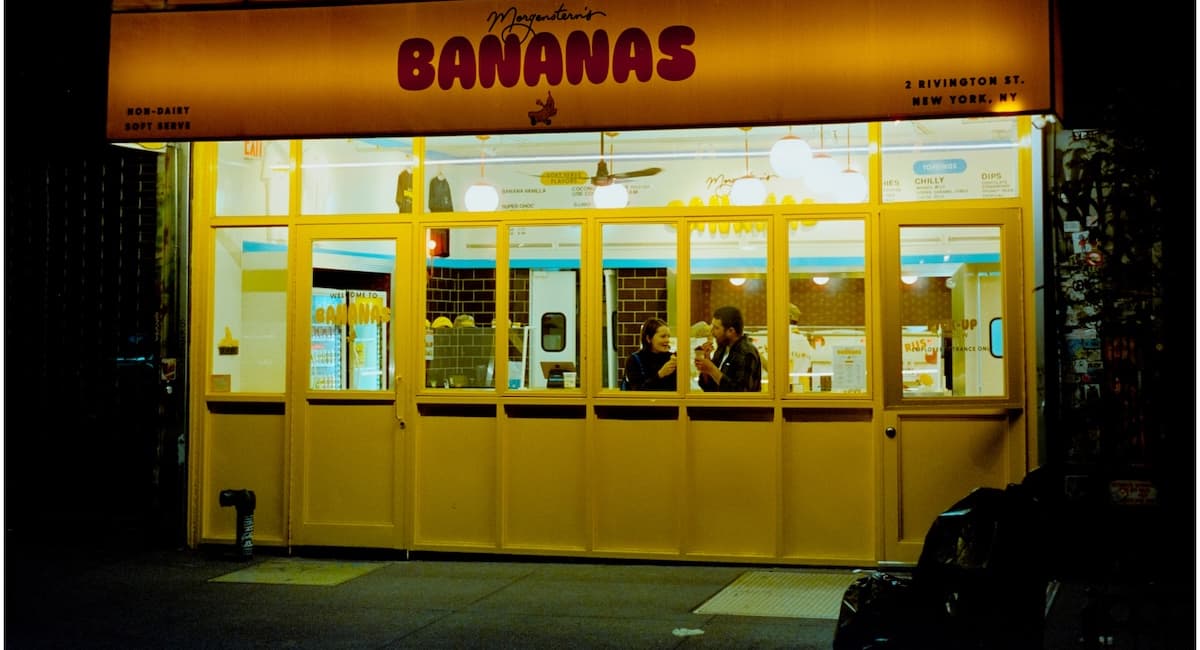
February 2, 2026
Night in Manhattan on film
So I grabbed my Kiev 60 that day – you know, the Soviet beast that weighs about as much as a small tank.
 This was a lovely gift from my cousin and this particular unit was made in 1988 on Arsenal factory in Ukraine. At that time the world was already going crazy with autofocus and electronics but Kiev 60 has none of that. But that's kind of why I love it. It's all metal, fully mechanical, and when that shutter fires, everyone in a three-block radius hear it.
For those of you who haven't shot medium format before: the negatives are huge – 6x6cm. It feels massive compared to 35mm.
That means way more detail, better tonal range, and this specific depth that's hard to describe - the main thing that draw me into medium format and keep hostage. The images just feel very real.
 That day I finished work earlier and went around to finish my Kodak Gold 200, I had three frames left.
 A short stroll through West 4 and then to the "secret" Pier 57 rooftop to capture the Little Island from above
 Once the sun went down, I loaded up something special: Cinestill 800T. This film is basically repurposed movie film – they take Kodak's cinema stock and remove the anti-halation layer, which creates these dreamy red halos around lights. It's tungsten-balanced too, so all those warm streetlights and neon signs get rendered naturally instead of looking orange as hell, while everything else takes on this moody blue tone. Perfect for night shooting. I also had my tripod and a mechanical shutter remote with me.
First stop was the East Village to catch Eduardo Kobra's massive Michael Jackson mural at 11th and First Ave. This thing is five stories tall and shows MJ split down the middle – little Jackson 5 kid on one side, later-years Michael on the other, all done in Kobra's signature rainbow geometric style. Fun fact: Kobra defended keeping the mural up despite controversies, saying it's about Jackson's transformation "from black to white, kid to adult, from natural to unnatural". The Cinestill made the nearby streetlights bloom like soft red stars around the mural – exactly the vibe I was going for.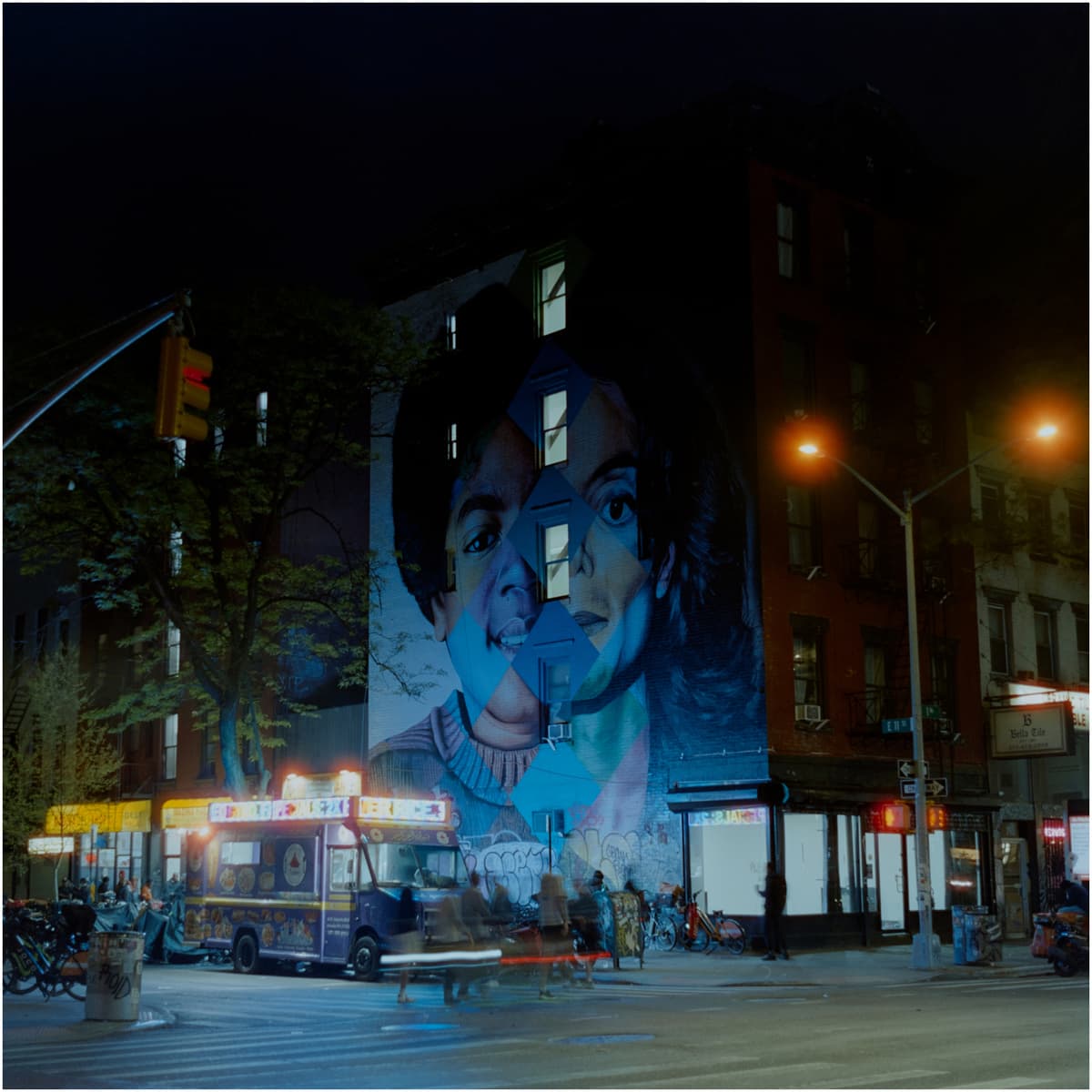
From there I wandered over to Morgenstern's Bananas cafe on Rivington street where I noticed this couple flirtig and eating ice-cream. I crossed the street and sort of hid in the shadow of the night to not gain too much attention and to not look like a creep. Nowadays people are weirded by any slight unusual behavior and sometimes flinch seeing a camera. I was stealth enough to capture this romantic night scene. I consider this photo a highlight of this night Next was Little Cupcake Bakeshop. It's a quintessential neighborhood anchor in NoLita. It balances a "small-town" nostalgia with the fashionable energy of Lower Manhattan. They have these neon-like signs that were perfect for Cinestill
 Surfing away from Price street a little I hit another night gem. Rintintin's wooden facade and oversized windows create that vintage-chic European bistro look with bold branding that feels like a cinematic snapshot of the neighborhood. The name is a nod to a French lucky charm puppet dolls Rintintin and Nénette, that were worn by Parisians during World War I as an amulet to protect against bombardments. The name was later given to the famous German Shepherd rescued from a French battlefield, who became a global icon of the silent film era.


I passed Washington Square Park and reached the famous McDougal Street. It's named after Alexander McDougall, a Scottish immigrant who started as a milk delivery boy and became a Revolutionary War major general, the first president of the Bank of New York, and was nicknamed "the Wilkes of America" after being jailed for writing revolutionary pamphlets against the British. But the street's real claim to fame is the Beat Generation — Caffe Reggio, which opened in 1927 and introduced cappuccino to America using an original 1902 espresso machine, became a hangout for Kerouac and Ginsberg, while Cafe Wha? is where a 19-year-old Bob Dylan performed his first NYC gig in 1961, and where Jimi Hendrix later played five sets a night for tip money. The whole street still has that frozen-in-time 1960s vibe, largely thanks to the 1969 Greenwich Village Historic District designation that preserved the unchanged cafe facades and interiors.
The street is now densely packed with 36 restaurants between Bleecker and West Fourth streets alone, plus comedy clubs like the renowned Comedy Cellar, late-night eateries, bars, and a mix of students, tourists, and food lovers. It's basically turned into this insane food corridor where century-old spots like Caffe Reggio and Minetta Tavern sit next to newer places serving everything from Ethiopian to Vietnamese to Belgian fries, all while Cafe Wha? still hosts live music almost every night — so the bohemian legacy lives on, just with way more tourists and NYU kids than beatniks these days Then I hit the Prince Street subway station – a photographer's pilgrimage site. I noticed it's usually being photographed during the day with a lot of tourists, but people rarely see it in a cozy 'domestic' condition.
 Reached the NOLITA area after that and stumbled upon Carbone on Thompson Street. It's this impossibly hard-to-book Italian-American restaurant that recreates the glory days of mid-century New York red-sauce joints with tuxedo-clad captains, velvet booths, theatrical tableside service, and dishes like their famous Spicy Rigatoni Vodka and Veal Parmesan. I've never dined there, but I like the atmosphere at the entrance
 Travelled down and I'malready on Mulberry Street in Little Italy that features illuminated cursive neon-style lights spelling out lyrics to "Nel Blu Dipinto Di Blu" (better known as "Volare"), which were installed in January 2023 as a gift from Italian donors and artisans to honor the Italian-American experience and thank the U.S. for welcoming Italian immigrants who "sailed over the Atlantic."
The handwritten-style verses hanging overhead include iconic lines like "Penso che un sogno così non ritorni mai più" and "Volare... oh, oh! Cantare... oh, oh, oh, oh!" centered near 173 Mulberry Street by Lunella Ristorante Viewing, creating this beautiful tribute where the song's lyrics literally float above the street like the immigrants' dreams once floated across the ocean I reached Chinatown and this mural by Toxicómano Callejero didn't leave me indifferent. Minus frame...Toxicómano Callejero means "Street Junkie" in Spanish. It's a Colombian street artist collective whose high-contrast work tackles police brutality, racism, media control, and human rights using graphic design techniques, popular culture imagery (from cartoons to comic books), and lettering inspired by 1950s pasquinades, the anonymous satirical messages designed to leave lasting impressions.
Influenced by 1980s and 90s Spanish punk rock, the collective intentionally stays anonymous, insisting "the wall is more important than the artist," and their murals can be found across Germany, Sweden, Mexico, Spain, the US, Colombia, and commissioned sites like The National Library of Colombia and the National Institute of Democracy in Washington D.C Going to the "touristic quarter" of Chinatown. Pell Street and its famous flying pegasus. This thing has been hanging overhead since 2017, and apparently, it's made entirely of dried egg noodles and was handcrafted in Shanghai. Once one of the most dangerous streets of New York City, Pell Street is very safe, and it's a magnet for tourists nowadays, featuring the whole row of eateries and boba tea stores.
 I didn't want to wrap the session up with something soul-less so I approached two Chinese gentlemen playing ping pong. Despite being reasonably skeptical at first, they eventually let me film their game. The long shutter helped me to keep them anonymous while simultaneously emphasizing the vigor of a friendly tournament.

This was a lovely gift from my cousin and this particular unit was made in 1988 on Arsenal factory in Ukraine. At that time the world was already going crazy with autofocus and electronics but Kiev 60 has none of that. But that's kind of why I love it. It's all metal, fully mechanical, and when that shutter fires, everyone in a three-block radius hear it. For those of you who haven't shot medium format before: the negatives are huge – 6x6cm. It feels massive compared to 35mm.
That means way more detail, better tonal range, and this specific depth that's hard to describe - the main thing that draw me into medium format and keep hostage. The images just feel very real.
That day I finished work earlier and went around to finish my Kodak Gold 200, I had three frames left.
A short stroll through West 4 and then to the "secret" Pier 57 rooftop to capture the Little Island from above
Once the sun went down, I loaded up something special: Cinestill 800T. This film is basically repurposed movie film – they take Kodak's cinema stock and remove the anti-halation layer, which creates these dreamy red halos around lights. It's tungsten-balanced too, so all those warm streetlights and neon signs get rendered naturally instead of looking orange as hell, while everything else takes on this moody blue tone. Perfect for night shooting. I also had my tripod and a mechanical shutter remote with me. First stop was the East Village to catch Eduardo Kobra's massive Michael Jackson mural at 11th and First Ave. This thing is five stories tall and shows MJ split down the middle – little Jackson 5 kid on one side, later-years Michael on the other, all done in Kobra's signature rainbow geometric style. Fun fact: Kobra defended keeping the mural up despite controversies, saying it's about Jackson's transformation "from black to white, kid to adult, from natural to unnatural". The Cinestill made the nearby streetlights bloom like soft red stars around the mural – exactly the vibe I was going for.
From there I wandered over to Morgenstern's Bananas cafe on Rivington street where I noticed this couple flirtig and eating ice-cream. I crossed the street and sort of hid in the shadow of the night to not gain too much attention and to not look like a creep. Nowadays people are weirded by any slight unusual behavior and sometimes flinch seeing a camera. I was stealth enough to capture this romantic night scene. I consider this photo a highlight of this night
Next was Little Cupcake Bakeshop. It's a quintessential neighborhood anchor in NoLita. It balances a "small-town" nostalgia with the fashionable energy of Lower Manhattan. They have these neon-like signs that were perfect for Cinestill
Surfing away from Price street a little I hit another night gem. Rintintin's wooden facade and oversized windows create that vintage-chic European bistro look with bold branding that feels like a cinematic snapshot of the neighborhood. The name is a nod to a French lucky charm puppet dolls Rintintin and Nénette, that were worn by Parisians during World War I as an amulet to protect against bombardments. The name was later given to the famous German Shepherd rescued from a French battlefield, who became a global icon of the silent film era.
I passed Washington Square Park and reached the famous McDougal Street. It's named after Alexander McDougall, a Scottish immigrant who started as a milk delivery boy and became a Revolutionary War major general, the first president of the Bank of New York, and was nicknamed "the Wilkes of America" after being jailed for writing revolutionary pamphlets against the British. But the street's real claim to fame is the Beat Generation — Caffe Reggio, which opened in 1927 and introduced cappuccino to America using an original 1902 espresso machine, became a hangout for Kerouac and Ginsberg, while Cafe Wha? is where a 19-year-old Bob Dylan performed his first NYC gig in 1961, and where Jimi Hendrix later played five sets a night for tip money. The whole street still has that frozen-in-time 1960s vibe, largely thanks to the 1969 Greenwich Village Historic District designation that preserved the unchanged cafe facades and interiors.
The street is now densely packed with 36 restaurants between Bleecker and West Fourth streets alone, plus comedy clubs like the renowned Comedy Cellar, late-night eateries, bars, and a mix of students, tourists, and food lovers. It's basically turned into this insane food corridor where century-old spots like Caffe Reggio and Minetta Tavern sit next to newer places serving everything from Ethiopian to Vietnamese to Belgian fries, all while Cafe Wha? still hosts live music almost every night — so the bohemian legacy lives on, just with way more tourists and NYU kids than beatniks these days
Then I hit the Prince Street subway station – a photographer's pilgrimage site. I noticed it's usually being photographed during the day with a lot of tourists, but people rarely see it in a cozy 'domestic' condition.
Reached the NOLITA area after that and stumbled upon Carbone on Thompson Street. It's this impossibly hard-to-book Italian-American restaurant that recreates the glory days of mid-century New York red-sauce joints with tuxedo-clad captains, velvet booths, theatrical tableside service, and dishes like their famous Spicy Rigatoni Vodka and Veal Parmesan. I've never dined there, but I like the atmosphere at the entrance
Travelled down and I'malready on Mulberry Street in Little Italy that features illuminated cursive neon-style lights spelling out lyrics to "Nel Blu Dipinto Di Blu" (better known as "Volare"), which were installed in January 2023 as a gift from Italian donors and artisans to honor the Italian-American experience and thank the U.S. for welcoming Italian immigrants who "sailed over the Atlantic." The handwritten-style verses hanging overhead include iconic lines like "Penso che un sogno così non ritorni mai più" and "Volare... oh, oh! Cantare... oh, oh, oh, oh!" centered near 173 Mulberry Street by Lunella Ristorante Viewing, creating this beautiful tribute where the song's lyrics literally float above the street like the immigrants' dreams once floated across the ocean
I reached Chinatown and this mural by Toxicómano Callejero didn't leave me indifferent. Minus frame...Toxicómano Callejero means "Street Junkie" in Spanish. It's a Colombian street artist collective whose high-contrast work tackles police brutality, racism, media control, and human rights using graphic design techniques, popular culture imagery (from cartoons to comic books), and lettering inspired by 1950s pasquinades, the anonymous satirical messages designed to leave lasting impressions. Influenced by 1980s and 90s Spanish punk rock, the collective intentionally stays anonymous, insisting "the wall is more important than the artist," and their murals can be found across Germany, Sweden, Mexico, Spain, the US, Colombia, and commissioned sites like The National Library of Colombia and the National Institute of Democracy in Washington D.C
Going to the "touristic quarter" of Chinatown. Pell Street and its famous flying pegasus. This thing has been hanging overhead since 2017, and apparently, it's made entirely of dried egg noodles and was handcrafted in Shanghai. Once one of the most dangerous streets of New York City, Pell Street is very safe, and it's a magnet for tourists nowadays, featuring the whole row of eateries and boba tea stores.
I didn't want to wrap the session up with something soul-less so I approached two Chinese gentlemen playing ping pong. Despite being reasonably skeptical at first, they eventually let me film their game. The long shutter helped me to keep them anonymous while simultaneously emphasizing the vigor of a friendly tournament.
Comments (2)
Вера
Очень красивые фотографии - яркие, насыщенные цвета, интересные ракурсы.
nyc angel
love long shutter! keep up!